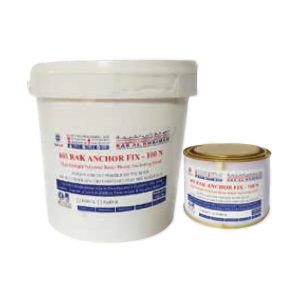

RAK EPOXY EP400 is a two components solvent free epoxy system consisting of a colored base resin, hardener. It is suitable for chemical protection coverings of industrial pavements, reinforced concrete and metallic structures.
RAK EPOXY EP400 adheres perfectly to a variety of supports like: concrete, metal, wood, stoneware, etc. Once cured, the product transforms to an anti-dust, chemical resistant continuous membrane. The applied coating is characterized excellent abrasive resistance and mechanical strength.
Advantages
- Solvent free and odorless
- Durable and low maintenance cost
- Excellent resistance to a wide range of chemicals
- High mechanical strength, with excellent abrasion resistance
- Excellent adhesion to the substrate. Bonding strength is greater than cohesive strength of concrete
- Less labour cost to achieve the required thickness (250 micron per coat)
Category: SPECIALITY PRODUCTS
Technical Properties
| Properties | Result |
|---|---|
| Appearance | Liquid coating |
| Color | Refer to RAKAM Color Chart |
| Viscosity at 25°C | 1500 MPa’s |
| Density at 25°C | 1.42 kg /L |
| VOC | 8.0 g/L |
| Solid Content | 100% |
| Pot-life time at 25°C | 60 minutes |
| Bond strength (ASTM D 4541) | 2.0 N / mm² Concrete Filler |
| Compressive strength (ASTM C 579) | 72 N / mm² |
| Flexural strength (ASTM C 580) | 36 N / mm² |
| Tensile strength (ASTM C 307) | 20 N / mm² |
| Abrasion Resistance (ASTM D 4060) | 68 mg, 1000 cycles |
| Water Absorption (BS EN 12390) | 0.05% |
| Open to vehicular tra c at 25°C | 48 hours |
| Service Temperature | -5°C to +80°C |
| Open to foot tra c at 25°C | 24 hours |
| All values are subject to 5-10 % tolerance. | |
Uses
RAK EPOXY EP400 is used as a resistant coating against chemicals and as an abrasion protective covering for floors. RAK EPOXY EP400 is an ideal system for heavy duty floor coating such as:
- Car parks
- Industrial floors
- Laboratories, loading docks ramps
- Showers
- Aircraft hangers
Instructions for use
Surface preparations
Concrete Substrates
The surface of the concrete to be prepared shall be sound, clean and uncontaminated.
This preparation shall be such as to leave a sound exposed concrete surface free from dust, loose particles and any deleterious matter. If the concrete surface is defective or has laitance, it must be cut back to a sound base. Excess laitance deposits are best removed by light mechanical scrabbling, grinding or grit/captive blasting followed by vacuum cleaning to remove dust debris.
Any blowholes, chipping or similar surface imperfections shall be repaired using EPOFINISH C, a solvent free epoxy resin repair mortar. Allow the repair material to harden.
Expansion joints shall be repaired using RAK EP, a High strength solvent free epoxy mortar.
New concrete or cementitious surfaces should be allowed to cure and have moisture content not exceeding 5%. Old or existing floor should be refurbished mechanically to ensure clear sound substrate.
Metal Substrates
All metal substrates should be blast cleaned to achieve a minimum of Sa2 ½ standard of roughness, an angular amplitude of at least 75 microns for pedestrian tra c and 100 microns for vehicular tra c. The coating system must be applied over the blasted steel surface immediately. If the standard of the surface falls below Sa2 ½ then the steel must be reblasted.
Priming
Highly porous concrete or concrete containing micro-silica must be treated with RAK EPOXY PRIMER, a Solvent-free high performance Epoxy primer.
In that case the primer should be applied by brush or roller on to the cleaned surface area (particularly hidden surfaces) at a rate of 5-6 m²/Liter.
The primer should be left to achieve a tack-free condition before applying the top coat. A second coat of primer may be required if the substrate is excessively porous.
In case of Metal substrates, the surface shall be treated with one coat of PRIMER EPOXY before the oxidation process occurs.
Mixing
RAK EPOXY EP400 is supplied in two pre-weighed packs (Component A – Base and Component B – Hardener) which are ready for immediate in-situ use. Stir in both components before use.
Transfer the entire contents of component B (Hardener) into the component A (Base) can and mix with low speed drill and paddle (200 – 300 rpm) for 2-3 minutes till obtaining a mix with uniform consistency. Scrape the sides and bottom of the can during mixing to ensure homogeneity.
Application
Apply two coats of RAK EPOXY EP400 with a roller, squeegee or airless spray to the primed tack free surface at a consumption rate of 3-m2/Kg. Each coat will be a minimum of 200-250 microns thick. The second coat shall be applied after the first coat is completely dry.
The total dry film thickness of the coating shall be a minimum of 500 microns.
For anti-slip flooring, silica sand (with suitable size) can be broadcasted on first coat in order to achieve leatherette like finish.
For heavy traffic areas such as drive lanes, ramps, turn areas, or other areas subjected to high abrasive tra c, apply a third coat RAK EPOXY EP400.
Cleaning
Tools and equipment should be cleaned with water immediately after use. Hardened material should be removed mechanically.
Spillages should be absorbed with sand or sawdust and disposed of in accordance with local regulations.
Consumption
3-4 m² / kg according to the porosity of support
Packaging
RAK EPOXY EP400 is supplied 5 and 15 Kg Kits, Colors Available
Recommendations
- RAK EPOXY EP400 should not be applied onto surfaces likely to su er from rising dampness or relative humidity > 70%
- RAK EPOXY EP400 should not be applied at temperature below +5°C
- RAK EPOXY EP400 should not be applied at asphalt floors or PVC tiles
- RAK EPOXY EP400 should be applied internally. If used exteriors it is strongly recommended to cover with one or two coats of RAK EPOXY EP400.
Chemical Resistance
Fully cured RAK EPOXY EP400 samples have been tested in a wide range of aggressive chemicals commonly found in industrial environments. Tests were performed in accordance to ASTM D543 standards over 7 days at +25°C.
| Material | Resistance |
|---|---|
| Hydrochloric Acid (20%) | Resistant |
| Sulphuric Acid (20%) | Resistant |
| Sodium Hydroxide (50%) | Resistant |
| Ammonia (10%) | Resistant |
| Petrol | Resistant |
| Oil | Resistant |
| Kerosene | Resistant |
| Butanol | Resistant |
| Skydrol | Resistant |
| Industrial Methylated Spirits | Resistant |
| Saturated Sugar Solution | Resistant |
| Urea (saturated) | Resistant |
| Bleach (5%) | Resistant |
Health & Safety
During application, wear appropriate protective clothing, goggles, gloves and respiratory equipment if necessary.
In case of contact with skin, rinse with water and again wash thoroughly with soap and water. In case of contact with eyes, rinse with plenty of water and seek medical advice accordingly.
If ingested, obtain medical attention immediately. Do not induce vomiting.